

Insights

The Australian Government announced significant reforms to negative gearing and capital gains tax as part of the 2026–27 Federal Budget on 12 May 2026.
These reforms have now been legislated and will change how losses from certain residential investment properties are treated from 1 July 2027. Properties held before the Budget announcement are generally protected, with investors purchasing established residential properties after the announcement, being the most impacted.
What is negative gearing?
Negative gearing occurs when the costs of owning an income-producing asset, such as an investment property, exceed the income it generates.
The term "gearing" refers to borrowing money to invest. When the interest and other holding costs are greater than the rental income received, the investment operates at a loss, creating a negatively geared position.
In Australia, that loss could generally be offset against other assessable income, such as salary or wages, reducing an investor’s overall taxable income. This treatment was possible because the tax system assesses a taxpayer’s total income across multiple sources when calculating their tax obligations. This increased the appeal of leveraged property investment by allowing eligible rental losses to reduce an investor’s taxable income.
How are negative gearing arrangements changing?
From 1 July 2027, investors will generally no longer be able to offset losses from established residential properties acquired from 7.30 pm AEST on 12 May 2026, with these losses being quarantined. Importantly, quarantined losses are not forfeited. They can be carried forward and applied against eligible residential property income or capital gains in future years. These losses may be applied against:
- Net income from residential property investments; or
- Capital gains arising from the sale of residential property.
What is the new-build exemption?
Eligible new-build residential properties will remain outside the scope of the new negative gearing restrictions.
The exemption is intended to support investment in new housing supply. By preserving the existing negative gearing treatment for eligible new-builds, the reforms seek to encourage investment in properties that add to Australia’s housing stock.
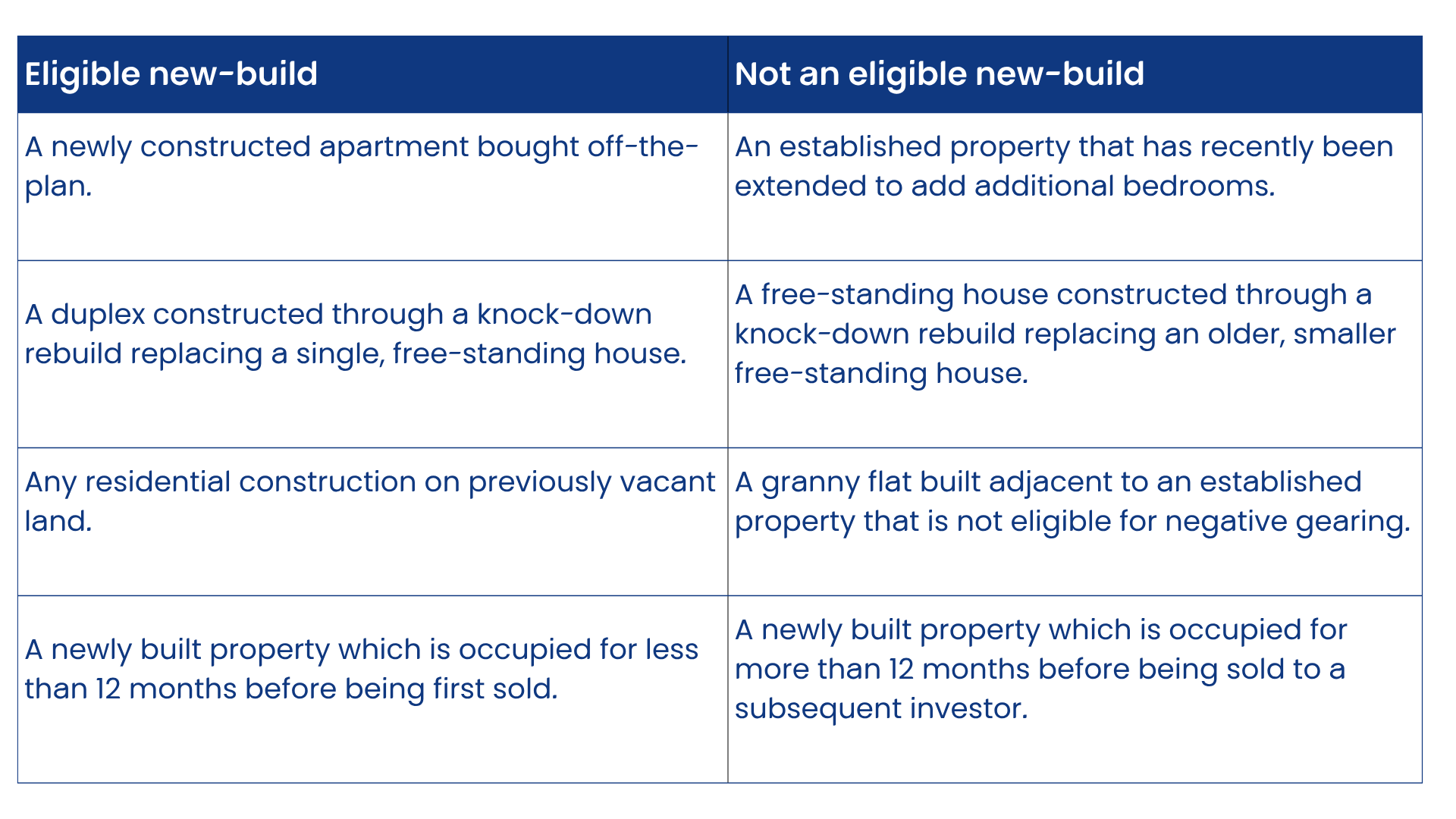
Investors in eligible new-build properties will continue to be able to offset eligible rental losses against other assessable income.
Will negative gearing impact superannuation and SMSFs?
Superannuation funds, including SMSFs, are excluded from the new negative gearing restrictions. However, this does not necessarily make property investment through superannuation suitable for every investor. SMSF trustees must continue to consider the fund’s investment strategy, cash flow, liquidity, diversification, borrowing restrictions and ongoing compliance obligations before proceeding with a property investment.
If you are impacted by the negative gearing reforms, what should you do next?
The reforms will affect investors differently depending on when a property was acquired, whether it is an eligible new-build, how the purchase is structured and the investor’s broader income and investment position.
Before acquiring or restructuring a residential property investment, consider:
- Confirming whether the property qualifies as an eligible new-build;
- Reviewing the expected cash flow without factoring in a tax benefit from any negative gearing losses;
- Maintaining clear records of acquisition dates, contracts and property expenditure;
- Considering how quarantined losses may affect the investment’s longer-term return; and
- Obtaining advice on the tax and ownership implications before entering into a transaction.
What should property investors consider?
The proposed reforms may change the after-tax cash flow and long-term economics of residential property investments acquired after the Budget announcement. As a result, investors may need to place greater emphasis on rental yield, debt levels, cash flow resilience and long-term capital growth, rather than relying on immediate tax deductions.
With the changes due to take effect from 1 July 2027, now is an appropriate time to review existing arrangements and understand how future transactions may be affected.
To discuss how the negative gearing reforms may affect you, please contact your local adviser.
16 Sept 2026
Author

Chris Roos
Partner
Perth
Related insights

Insights
The Federal Budget introduced a significant shift in how capital gains will be taxed in Australia. While the legislation has passed Parliament, the changes do not take effect until 1 July 2027. What is changing? The current 50% CGT discount will be replaced for individuals, trusts and partnerships, with cost...
Chris Roos
Partner
Perth

Insights
PKF Perth Corporate Finance (“PKF”) recently acted as financial adviser to Griffin Industrial Group ("Griffin Industrial", "Company") on a transaction with the Australian Business Growth Fund (“ABGF”), marking a significant milestone in the Company’s growth trajectory. Griffin Industrial brings together the capabilities of Griffin Marine and Westurn Engineering, delivering precision...

Matthew Hall
Executive Director
Perth

Insights
Whether you're buying a business, selling a business, or raising capital in Australia, each pathway comes with its own technical processes and risks. Our comprehensive guide to mergers & acquisitions and capital raising highlights the critical steps, risks, and tax considerations you need to know.The guide covers: The strategic importance...

2 contributors
Perth